Sudan’s Armed Forces (SAF) have deepened military relationships with Turkey and Russia over the past year, receiving Turkish combat drones already active in the war while negotiating additional Russian fighter jets and air-defense systems as part of a proposed naval-base arrangement that remains in draft form. Turkey’s drones are a confirmed, deployed capability; the new Russian jets are not yet delivered, tied instead to an unresolved 25-year Port Sudan lease first floated to Sudan’s former government nearly two decades ago. Both arrangements sit alongside longer-standing support from Egypt, Iran, Saudi Arabia and Qatar, giving SAF a broader coalition of state backers than the RSF’s UAE-centered network, according to Georgetown University’s Security Studies Review.
Turkish Drones Reshape Air War
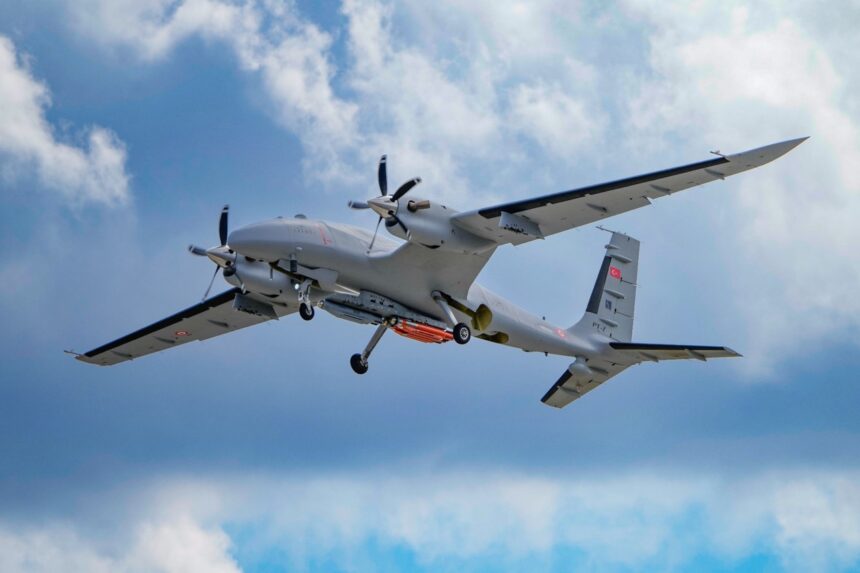
Turkish-made Bayraktar Akinci drones, built by Istanbul-based Baykar, have become SAF’s most visible counter-drone weapon. Defence-Blog reported, citing video from the Turkish outlet Clash Report, that SAF has destroyed at least six Chinese-made CH-95 drones flown by the RSF since late June, several in air-to-air engagements, with the most recent claimed kill on August 17. Defence-Blog itself flags inconsistent naming between “CH-95” and “FH-95” in the footage and reporting, so that count reflects Clash Report’s tally rather than independent verification.
Two other engagements are separately documented. SAF said at a May 4 press conference that its air defenses shot down a drone launched from Ethiopia’s Bahir Dar airport on March 17 and traced its serial number back to the UAE, a claim Janes reported directly from the SAF statement without independently confirming which aircraft carried out the shootdown. Separately, Military Africa reported, citing Turkish media from early July, that in May an SAF Akıncı destroyed a rival Akıncı-type drone suspected of Ethiopian origin using a Roketsan EREN loitering munition – a 35-kilogram weapon with a stated range near 100 kilometers – in what analysts described as among the war’s first drone-on-drone kills.
Documents reviewed by the European Centre for Strategic Studies and Policy reportedly showed Baykar supplying SAF directly with TB2s, ground control stations and roughly 600 warheads, in a contract valued at an estimated $120 million. Those drones were described as a key factor in SAF’s 2025 recapture of Khartoum from the RSF by Fair Observer, though Turkey has never officially confirmed direct government-to-government transfers. Hubert Kinkoh, an Africa researcher at Chatham House, writes that the drones have reached SAF at “virtually no diplomatic cost” to Ankara, which publicly denies supplying them directly, while Iran is separately alleged to have supplied drones to SAF – an allegation the army also denies.
Sudan’s drone war has become one of the conflict’s deadliest features regardless of source: UN figures cited by Kinkoh found drone strikes caused more than 880 civilian deaths between January and April 2026 alone, over 80 percent of all documented conflict deaths in that period.
Russia’s Existing Fleet And New Proposal
Russian-origin weapons are not new to SAF — they are the backbone of its current air force. MiG-29 fighters procured from Russia in the 2000s and Su-24M strike aircraft acquired secondhand from Belarus in the early 2010s form the core of SAF’s fixed-wing fleet, according to Military Watch Magazine, alongside older Su-25 ground-attack jets. Legacy Antonov transport aircraft have also been pressed into service as makeshift bombers, and a France 24 Observers investigation conducted with C4ADS found that only SAF possesses aircraft capable of the type of aerial chlorine-barrel drop documented near the al-Jaili refinery in September 2024 — attacks the US State Department later cited in determining Sudan’s government used chemical weapons in 2024.
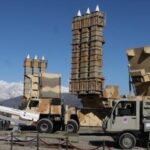
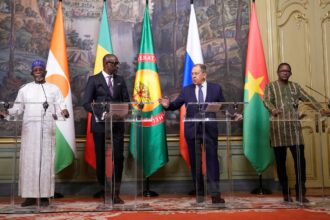
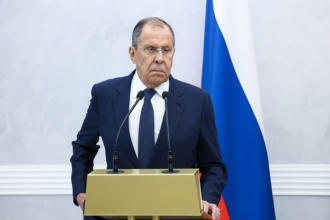
Separately, Sudan has offered Russia a proposed 25-year lease on a naval base at Port Sudan, first reported by the Wall Street Journal in December 2025. Under the draft terms, Russia would station up to 300 personnel and four warships, including nuclear-powered vessels, and gain access to gold-mining concessions in Sudan, Africa’s third-largest gold producer, while SAF would receive new Su-30 and Su-35 fighter jets, additional air-defense systems and preferentially priced weapons — none of which had been confirmed as delivered as of the Journal’s report. The proposal has a long history: Sudan’s ousted dictator Omar al-Bashir first offered Russia access to Port Sudan in 2017, and a 2020 intergovernmental agreement authorized a near-identical Russian logistics point before the deal stalled amid US pressure and Sudan’s 2019 political transition.
The current push marks a reversal for Moscow, which backed the RSF-adjacent Wagner network for years before Africa Corps formally replaced it in 2024 and Russia shifted declared support to SAF, according to Foreign Policy. Sudanese analyst Osman Al Mirghany told the North Africa Post, as cited by Eurasia Review, that the army was in “desperate need of weapons, ammunition and spare parts,” calling the trade its best resupply option. Internal Sudanese politics have repeatedly slowed signing — as of the Journal’s December report, the agreement remained in draft form.
Wider Coalition, Accountability Gap
SAF’s foreign backing extends well beyond Turkey and Russia, drawing on a coalition Georgetown’s Security Studies Review frames as reflecting at least ten countries’ overlapping interests rather than a single patron on either side. Egypt has provided ammunition, training and Chinese-made K-8 jets, support the EU Asylum Agency traces to Nile water security and decades of military ties with Khartoum, though Cairo’s foreign ministry has denied direct military involvement. Saudi Arabia has offered financial and logistical backing that let SAF sustain operations from Port Sudan, tied to billions of dollars in Saudi agricultural investment along SAF-held Nile territory and plans for an additional $50 billion in postwar reconstruction funding, according to Horn Review. Qatar has hosted former Islamist officials from the ousted Bashir government whom the European Council on Foreign Relations describes as central to the financial networks and weapons supplying SAF’s war effort, while Eritrea’s President Isaias Afwerki aligned with SAF chief Abdel Fattah al-Burhan largely for immediate wartime reasons following his own falling-out with the UAE, per a separate Horn Review analysis.
That backing does not remove scrutiny of SAF’s own conduct: the US State Department determined in April 2025 that Sudan’s government used chemical weapons in 2024, backed since by two rounds of sanctions, an allegation Khartoum has rejected as “baseless.” The through-line for SAF’s foreign backing is the same one now visible on the RSF side: Turkish drones are actively shaping the air war today, while Russia’s naval-base bargaining ties long-term Red Sea access and mining concessions to weapons still not delivered — two different mechanisms, but both trading strategic access for military support, with formal denials on all sides keeping individual transfers hard to attribute.