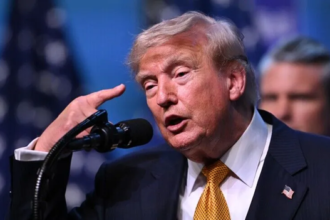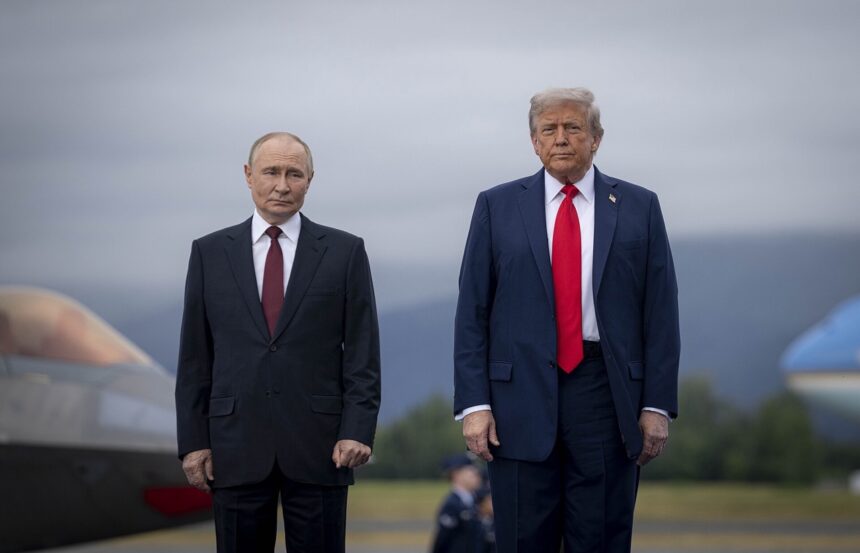
One year after Donald Trump and Vladimir Putin met in Anchorage, the Russian concept of the so called “spirit of Anchorage” has effectively disappeared. The phrase was never a formal agreement or documented diplomatic framework, but it became a political narrative promoted by Moscow to suggest that the summit produced an implicit understanding between Washington and Moscow over the future of Ukraine. A year ago the summit ended without a ceasefire or peace settlement – Trump and Putin left Alaska with, in Trump’s own words, “no deal until there’s a deal,” although both leaders described the talks as productive.
For Moscow, the meeting itself represented a strategic opportunity: the return of direct U.S.-Russian diplomacy and the possibility that Ukraine and Europe could be pressured from outside the negotiating room. The value was never a signed agreement but the political utility of the idea itself, one Russian officials could define however suited them at any given moment.
What Anchorage Meant For Moscow
The Russian interpretation of Anchorage was not only about ending the war. It was about changing the balance of influence around it. Foreign Minister Sergei Lavrov captured this directly, saying afterward that “we accepted the United States’ proposal… having accepted their proposal, we’ve effectively fulfilled the task of resolving the Ukrainian issue and can move on to full-scale, broad, mutually beneficial cooperation.” Lavrov’s statement reflected Moscow’s interpretation of the summit, not the existence of a documented U.S.-Russian agreement. Influential foreign-policy analyst Fyodor Lukyanov argued the summit exposed a gap between Washington and European capitals, with the U.S. increasingly unwilling to pursue the same objectives as Europe.
This interpretation explains why Moscow kept promoting the “spirit of Anchorage” long after the summit produced nothing in writing: it was a tool for separating Washington from its European allies and convincing the United States that Ukraine’s resistance, not Russia’s invasion, was the main obstacle to peace. When that project failed, the phrase became just as useful in reverse — a way for Russia to accuse Washington publicly of failing to honor commitments that were never actually specified.
The Peace Plan That Excluded Kyiv
The later 28-point U.S. peace proposal exposed the limits of that approach. The plan, which emerged from U.S.-Russian back-channel discussions involving Trump administration officials and Russian representatives, according to reports at the time, would have handed Russia control of Ukraine’s Donbas region – including territory Kyiv still held — in exchange for U.S. security guarantees, while freezing front lines in Kherson and Zaporizhzhia. Neither Ukraine nor Europe, which has committed more money to Kyiv’s defense than Washington since 2022, was part of drafting it.
Kyiv rejected the plan’s underlying logic, arguing that peace required a ceasefire, enforceable security guarantees and respect for Ukraine’s sovereignty rather than territorial concessions folded into a U.S.-Russian framework. The 28-point framework itself did not survive contact with these objections: it was narrowed to 19 points within days under European and Ukrainian pressure, then further reworked into roughly 20 points by early 2026, and no version has become a signed agreement or shown evidence of active negotiation since. The plan’s real legacy was procedural rather than textual – it confirmed for Kyiv and European capitals that a settlement drafted without them could not hold.
Europe Reclaims A Seat At The Table
The failure of the Anchorage approach became clear when Europe returned to the center of the discussion. France, Germany and the United Kingdom – known as the E3 – began developing their own negotiating format. The New York Times reported, citing European officials, that Washington and Moscow should not be able to reach a settlement affecting European security without European participation, according to the NYT report. Europe’s influence rested on more than diplomacy: through mechanisms such as the Prioritized Ukraine Requirements List (PURL), European countries finance purchases of U.S. weapons for Ukraine, making them active participants in the supply chain rather than passive observers.
This directly contradicts the narrative, promoted at times by Russian officials and commentators, that the United States simply abandoned Ukraine. Washington changed the structure of its support, but American weapons, intelligence cooperation and military assistance continued – Russian officials themselves have separately complained that U.S. intelligence support was still helping Ukraine strike Russian targets. As the diplomatic shortcut failed, Moscow’s rhetoric shifted accordingly, increasingly portraying Europe rather than Washington as the main obstacle to peace, alongside a rise in suspected sabotage operations, surveillance and attacks on infrastructure and defense companies supporting Ukraine across the continent – pressure European governments have absorbed without stepping back from Kyiv.
A Familiar Trap For Washington And Moscow
Anchorage demonstrated the limits of great-power coercion in Ukraine. The Iran crisis is now testing the same assumption from the American side: that economic and military pressure alone can force a political outcome. Washington has spent months escalating pressure on Tehran – including President Trump’s August 19 declaration of an “ECONOMIC D-DAY” – without a settlement, even as US Patriot and THAAD interceptor stockpiles have fallen to roughly a third and a half of pre-war levels, according to CSIS. As in Ukraine, real leverage increasingly sits with actors outside the direct confrontation: China remains Iran’s largest oil customer, giving Beijing outsized influence over whether Washington’s sanctions campaign succeeds where predecessors failed.
Europe’s shift from anxious observer to active participant suggests the passive posture Moscow counted on in August 2025 no longer holds. Whether Beijing plays a comparable role in Iran’s case remains untested, but the underlying pattern is the same: when a war’s principal antagonists reach the limits of what force or pressure alone can achieve, the outcome increasingly depends on those still standing at the edges of the table. Neither Anchorage nor any version of the 28-point plan settled that question for Ukraine; whether Washington’s economic offensive settles it for Iran is, a year on, exactly the kind of question great-power diplomacy alone has so far proven unable to answer.