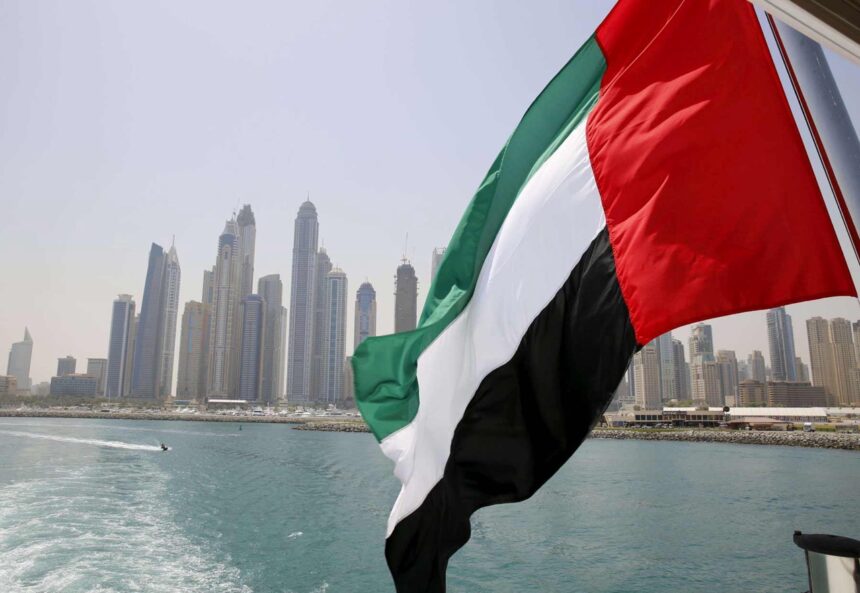
The United Arab Emirates has suspended all trade, commercial and financial transactions with Iran, reopening a diplomatic and economic rupture that first emerged after the United States and Israel went to war with Iran on February 28. According to the UAE Ministry of Defense, cited by Reuters, the country’s air defenses detected two ballistic missiles launched from Iran toward maritime traffic, with one splashing down outside the UAE’s territorial waters and the second landing inside them. No casualties or damage were reported, and neither Reuters nor U.S. Central Command has independently verified the launch data. The UAE’s Foreign Ministry said the suspension would remain in effect “until further notice,” citing regional escalations that undermine peace and security.
Iran’s Foreign Ministry rejected the accusation as baseless. Spokesman Esmaeil Baghaei described the incident as a “false flag operation” and said the allegation contradicted the principle of good-neighborly relations. The denial came a day after a 60-day window for U.S.-Iran peace talks expired without a breakthrough, with President Donald Trump subsequently saying no negotiations were underway. If confirmed, Tuesday’s launches would represent the first attack the UAE has publicly attributed to Iran since May, following a lull in a conflict that saw Iran fire more than 530 ballistic missiles and over 2,200 drones toward the UAE during the opening six weeks of the war.
The suspension targets one of Iran’s most important commercial relationships. The UAE has consistently ranked among Iran’s largest trading partners alongside China, while roughly a third of Iranian imports have historically moved through re-export channels centered on Dubai’s Jebel Ali Port, a critical logistics hub linking Iran to global markets despite successive rounds of Western sanctions. Dubai’s exchange houses have also served as an important financial conduit for Iranian businesses seeking access to hard currency. The UAE suspended cargo shipping with Iran in early March, shortly after the outbreak of hostilities, before allowing trade through Jebel Ali to resume in late June. Retired U.S. Army Brig. Gen. Mark Kimmitt told Al Jazeera that the renewed embargo could ultimately prove more economically damaging than additional U.S. sanctions because of Dubai’s central role in regional trade and finance.
Whether the dispute remains an economic confrontation or evolves into renewed military escalation will depend on two unresolved questions: whether independent evidence corroborates the UAE’s account of the missile launches, and whether either government chooses to respond beyond diplomatic and commercial measures. For now, the suspension underscores how quickly Gulf states are prepared to weaponize economic ties when regional security deteriorates, even as responsibility for the latest incident remains disputed.