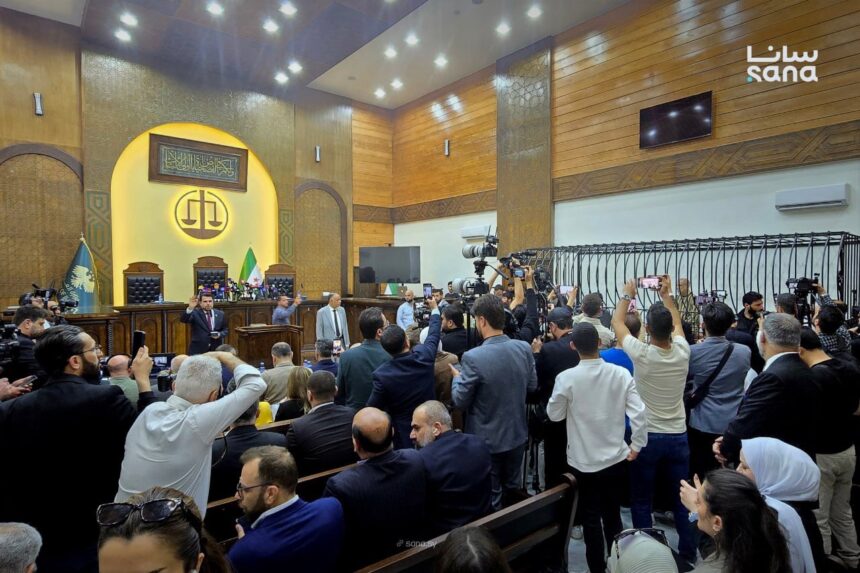
A Damascus court has sentenced ousted Syrian president Bashar al-Assad to death in absentia, a landmark Syrian conviction against the former ruler since his government collapsed in December 2024. Reuters reported that Assad was convicted on charges including killings, torture and arbitrary arrest during Syria’s nearly 14-year war. His brother Maher al-Assad, former commander of the Fourth Armoured Division, was also sentenced to death in absentia.
The only senior Assad-era figure sentenced in custody was Atef Najib, Assad’s cousin and former head of political security in Deraa province. AP reported that Judge Fakhareddine al-Aryan delivered the verdict in a live televised session, saying Assad had used state agencies to commit war crimes and crimes against humanity.
Najib’s case carries heavy symbolic weight. Deraa was the birthplace of Syria’s 2011 uprising, after teenagers accused of writing anti-government graffiti were detained and tortured. Syrian Network for Human Rights trial monitoring links Najib’s case to his command role in the Political Security Branch in Deraa and to charges over detention, torture and the violent suppression of early protests. Human Rights Watch documented that Syrian security forces in Deraa used lethal force, rooftop snipers and denial of medical access against protesters in 2011.
The legal basis is still contested. SNHR says Syria’s penal code does not yet define war crimes, crimes against humanity or command responsibility as standalone offences. The Najib case therefore rests on a mixed framework: Syria’s 1949 Penal Code, Anti-Torture Law No. 16 of 2022, the 2025 Transitional Constitutional Declaration and international law used as an interpretive standard.
The ruling highlights Syria’s unfinished accountability process. Assad and Maher remain in Russia, and Moscow has not handed them over. Reuters reported in January 2025 that Syria’s new leadership had asked Russia to surrender Assad, while Moscow declined to comment, and no public request or handover timetable has followed since.
That dispute has not broken Syrian-Russian relations. On August 9, Syria and Russia reached a memorandum reorganizing Moscow’s military presence at Hmeimim and Tartus. SANA reported that Syria will assume management of civilian facilities, including Hmeimim Airport and the fourth commercial berth at Tartus Port, while military sites will be reclassified as joint training and qualification centres. Damascus has gained more formal sovereignty over the coast, while Russia has preserved a reduced but still important foothold.