President Lee Jae Myung used the start of this year’s Ulchi Freedom Shield exercises to make an argument that would once have sounded uncomfortable in Seoul: South Korea needs to become better able to defend itself. His comments came after U.S. President Donald Trump ordered the Pentagon to substantially reduce joint military exercises with South Korea, reviving questions over the future of a military alliance that has underpinned South Korean security for more than 70 years.
Lee has not called for the alliance to end. He has instead described it as essential while backing stronger independent defense capabilities, a faster transfer of wartime operational control (OPCON) to Seoul, and accelerated development of nuclear-powered submarines. His message reflects a broader reality emerging across the Indo-Pacific: Washington increasingly expects allies to shoulder more responsibility for their own conventional defense while preserving America’s role as the ultimate strategic guarantor.
The resulting question is therefore no longer hypothetical. Could South Korea defend itself if the United States played a much smaller military role? Conventionally, the answer is increasingly yes. Strategically, however, Seoul remains dependent on capabilities it cannot replace simply by buying more tanks, missiles or aircraft.
South Korea Is No Longer the Weak Partner
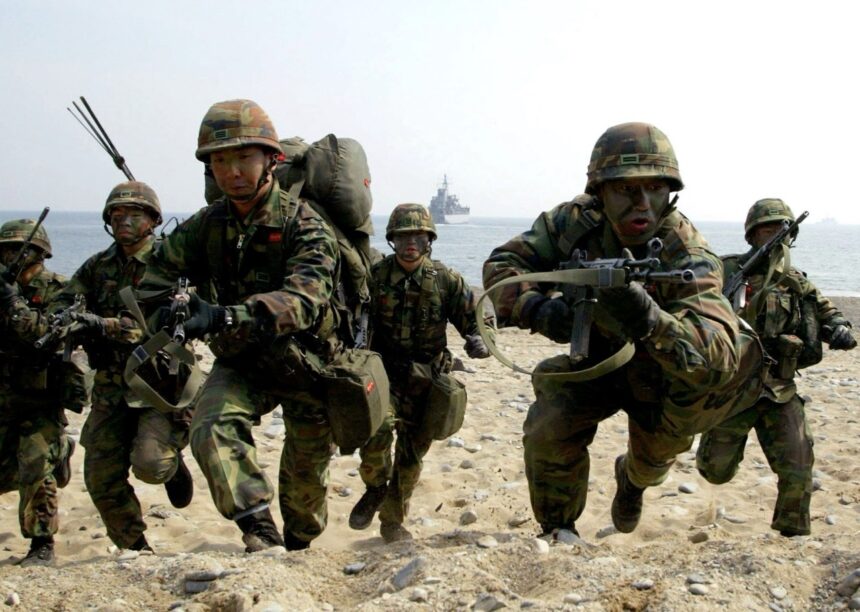
The South Korean military of 2026 bears little resemblance to the force that depended heavily on American protection during the Cold War. Seoul has spent decades investing in precision-strike systems, layered air defense, advanced naval forces, submarines, ballistic and cruise missiles, cyber capabilities and integrated command-and-control networks. Its finalized 2026 defense budget totals 65.9 trillion won, a 7.5 percent increase over 2025, according to reporting on the budget approved by the National Assembly.
The scale of that investment is substantial. SIPRI estimated South Korea’s military expenditure at $47.8 billion in 2025, up 2.6 percent from the previous year. Seoul has increasingly directed spending toward missile defense, surveillance, precision strike and the three-axis deterrence architecture designed specifically around the North Korean threat.
Just as important is how that money is being spent. South Korea now designs and manufactures many of its own advanced weapons, including K2 main battle tanks, K9 self-propelled howitzers, Chunmoo multiple rocket launchers, destroyers, submarines and combat aircraft. Poland has become Seoul’s largest defense customer, and in July 2025 the two governments finalized a second major K2 contract, following the broader 2022 package covering tanks, K9 howitzers, FA-50 aircraft and Chunmoo launchers. The KF-21 Boramae has meanwhile moved into serial production, giving South Korea an indigenous fighter program it did not possess a decade ago.
That industrial base matters because prolonged war is ultimately a contest of replacement, repair and ammunition production as much as one of forces available on the first day. South Korea has therefore become not only a recipient of American protection but an increasingly important security provider and arms exporter in its own right.
What America Actually Provides
The visible symbol of American protection is the roughly 28,500 U.S. military personnel stationed in South Korea. But counting soldiers understates the alliance’s value. U.S. Forces Korea anchors a combined command architecture through which South Korean and American forces train, plan and would operate together in wartime.
Washington also provides capabilities that are far harder to replace than ground forces. U.S. space-based missile warning, intelligence collection, surveillance and long-range logistics significantly strengthen South Korea’s ability to detect, track and respond to North Korean military activity. American forces on the peninsula are also connected to a much broader military network spanning Japan, Guam and the rest of the Indo-Pacific.
Building a comparable architecture independently would require years of investment and institutional change. This is why the planned transfer of wartime operational control matters. South Korea already commands its forces in peacetime, but wartime planning has historically operated through the Combined Forces Command under a U.S. general. Moving toward a South Korean-led command structure is therefore part of a broader transition in which Seoul absorbs more operational responsibility while Washington continues supplying high-end strategic support.
Could Seoul Stop a North Korean Attack Alone?
North Korea remains one of the world’s most heavily militarized states. It possesses a large standing army, extensive artillery, fortified positions and expanding missile forces capable of inflicting severe damage during the opening stages of a conflict. Pyongyang has also continued modernizing both nuclear and conventional systems rather than relying solely on its older numerical advantages.
South Korea’s principal answer is its three-axis defense architecture: Kill Chain, Korea Air and Missile Defense, and Korea Massive Punishment and Retaliation. Together, they are intended to detect preparations for attack, intercept incoming missiles and preserve the ability to strike North Korean command centers and launch facilities. Their effectiveness, however, depends heavily on the speed with which intelligence can move from sensors to decision-makers and then to weapons.
Any disruption to that chain – or a saturation attack overwhelming command-and-control systems – could reduce South Korea’s qualitative advantage. But the broader conventional balance has shifted steadily in Seoul’s favor. South Korea enjoys major advantages in modern air power, naval capability, precision strike, communications, logistics and industrial sustainment.
That does not mean war would be short or inexpensive. North Korea does not need to conquer Seoul to devastate it. Missile strikes, long-range artillery and attacks on critical infrastructure could cause enormous civilian and economic losses before South Korea’s technological and industrial advantages became decisive. The more defensible conclusion is narrower: South Korea increasingly possesses the conventional capacity to deny North Korea a military victory even if the American ground presence were substantially reduced.
Nuclear Weapons Change the Equation
The conventional balance becomes far less reassuring once nuclear weapons enter the calculation. According to the SIPRI Yearbook 2026, North Korea may have assembled around 60 nuclear warheads and possesses enough fissile material to produce at least 30 more.
South Korea has no equivalent weapon. Instead, its ultimate security rests on American extended deterrence: Washington’s commitment to defend Seoul using the full range of U.S. capabilities, including nuclear forces. Missile defenses can reduce vulnerability, and precision-strike systems can threaten North Korean launch sites, but neither guarantees that every nuclear weapon can be destroyed or intercepted before use.
North Korea’s tactical nuclear capabilities may also function as an escalation shield. Their existence forces South Korean leaders to weigh any major conventional response against the possibility that escalation could cross the nuclear threshold. That complicates the logic of conventional superiority: Seoul could possess the stronger military overall and still face severe constraints in a crisis because Pyongyang retains nuclear weapons.
Without the American nuclear umbrella, South Korea would therefore confront a strategic problem it cannot solve simply through larger conventional budgets. Seoul would eventually have to choose between accepting a permanent nuclear imbalance with the North or reconsidering whether remaining non-nuclear continued to serve its security interests.
A Smaller Alliance Could Produce a Bigger Nuclear Question
That debate already exists inside South Korea. CSIS analysis has found that public opinion polls have repeatedly shown majority support for an indigenous South Korean nuclear arsenal, often exceeding 70 percent, although elite and governmental support remains considerably lower.
Washington and Seoul have so far responded by strengthening nuclear consultation rather than pursuing proliferation. The 2023 Washington Declaration established the Nuclear Consultative Group, giving South Korea a larger role in bilateral discussions on nuclear and strategic planning. The mechanism exists precisely because North Korea’s expanding arsenal has made reassurance of Seoul increasingly important.
A reduced American conventional footprint therefore would not necessarily mean that the alliance was becoming irrelevant. It could instead produce a new division of labor: South Korea assumes primary responsibility for ground warfare, conventional strike and much of its own territorial defense, while Washington continues providing strategic intelligence, reinforcement capabilities and nuclear deterrence.
Complete American disengagement would be a different matter. South Korea possesses the wealth, technology and industrial base needed to build a far more autonomous defense establishment. But losing the U.S. nuclear guarantee could push Seoul toward choices with consequences far beyond the peninsula, including renewed nuclear debate in Japan and additional strain on the global non-proliferation system.
South Korea is approaching the point where it may no longer need American soldiers to carry the main conventional burden of defending the peninsula. That is not the same as being able to replace the United States.
The future of the alliance may therefore depend less on how many American troops remain south of the Demilitarized Zone than on whether Seoul continues to believe Washington would provide the intelligence, strategic reach and ultimately the nuclear protection that conventional superiority alone cannot replace.