
Analysis
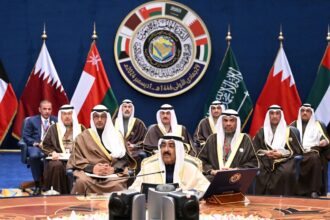
A New Gulf Order Emerges Under Fire
The US-Iran war is achieving what decades of summits and declarations could not: it has handed the Gulf monarchies a single, immediate security problem. Iranian missiles and drones have repeatedly struck Gulf territory. Reported strikes on Kuwaiti electricity-generation and water-desalination facilities took generating units out of service. Yemen's Iran-aligned Houthis have declared a blockade of Saudi Arabia and warned shipping companies against calling at its ports; reports have placed several vessels on altered courses. The monarchies did not choose this war, yet they absorb much of the retaliation while exercising little control over either Washington's campaign or Tehran's response.That shared exposure may now become the foundation of a new regional order: less ideological, more transactional, and increasingly set on reducing dependence on any single outside protector.The Dual-Chokepoint TrapTehran's pressure is increasingly operating across two waterways at once. As hostilities threaten traffic through the Strait of Hormuz, the Houthi blockade threat…
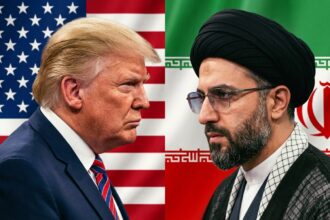
Can Iran Be Defeated Without a Ground War?
The United States can almost certainly destroy more of Iran's military than Iran can destroy America's. That, however, does not answer the question now confronting Washington: can overwhelming military superiority produce political victory without putting American troops inside Iran?After eleven consecutive nights of strikes, U.S. forces have demonstrated that they can penetrate Iranian airspace almost at will, repeatedly attacking command centers, missile infrastructure, air-defense systems and military facilities across the country. Yet every additional wave of bombing exposes the same strategic dilemma. Destroying targets is relatively straightforward. Deciding what political outcome those strikes are meant to achieve is considerably harder.Whether Iran can be defeated without a ground war depends almost entirely on what Washington means by "defeat."The answer changes depending on which objective the United States is pursuing.Defeating Iran could mean:destroying its conventional military;forcing political concessions;overthrowing the Islamic Republic;permanently eliminating its nuclear and missile programs.Only the first objective is clearly…
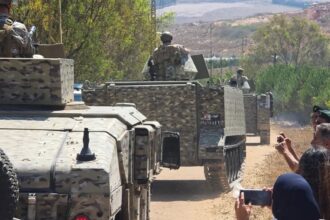
Lebanon Tests Peace Amid Regional War
Lebanon’s most promising peace experiment in years began on Tuesday with a small, tangible act: Lebanese army units walked into Zawtar al-Gharbiyeh after Israeli forces pulled out of the southern village.It was the first handover of ground under a US-brokered framework meant to replace both Israeli occupation and Hezbollah’s independent arsenal with the authority of the Lebanese state. As the US–Iran war spreads across Gulf bases and the Strait of Hormuz, that made Lebanon the source of something the region has almost stopped producing: a negotiated security deal actually changing who controls the ground.The contrast was stark. The same week, Yemen’s Iran-aligned Houthis declared a naval blockade on Saudi Arabia and warned shipping lines away from Saudi ports. Days earlier, Reuters reported that Tehran had told the Houthis to be ready to close the Bab al-Mandeb if US strikes hit Iran’s power grid. As Washington works to loosen Iran’s hold…

Trump’s Iran War Risks Becoming a Quagmire
The Trump administration is drifting back toward its original goal of Iranian regime change after months of diplomacy failed to end the war, Financial Times chief foreign affairs commentator Gideon Rachman argued, warning that President Donald Trump's foreign policy legacy is likely to be defined by a conflict for which Washington currently has no plausible path to victory, according to the Financial Times.A shrinking definition of successRachman noted that the US national security establishment is already scaling back what it considers an acceptable outcome. At last week's Aspen Security Forum, former Defense Secretary Mark Esper, who served during Trump's first term, argued that success should be measured by two benchmarks: a return to full, unrestricted maritime traffic through the Strait of Hormuz, and a nuclear agreement with Iran stronger than the 2015 deal negotiated under President Barack Obama, according to the Irish Times. Esper argued airstrikes alone cannot deliver that…

Ukraine Is Teaching NATO a Faster Way to Fight
When Russia launched its full-scale invasion in 2022, Ukraine depended heavily on Western weapons to survive. Four years later, the relationship is becoming more reciprocal. While Kyiv still relies on allied military aid, NATO and European governments are increasingly turning to Ukraine for something they cannot manufacture themselves: combat-tested knowledge of how modern wars evolve.That knowledge extends well beyond drones or missiles. Ukraine has built a military innovation ecosystem that links frontline soldiers, engineers, software developers and manufacturers in a continuous cycle of experimentation. Equipment is modified, tested under combat conditions, refined and returned to the battlefield at a pace rarely seen in conventional defence procurement. NATO is now beginning to absorb parts of that model.The shift was visible at NATO's July summit in Ankara. Alliance members announced more than $40 billion in counter-drone investment over the next five years, pledged to increase drone-operator training fivefold by the end of…
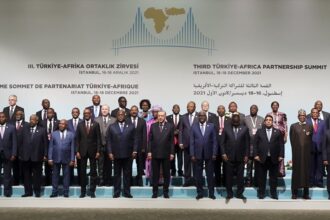
How Turkey Builds Power Through Africa
Turkey's growing presence in Africa is often described as another foreign power crowding onto a busy continent. That understates what Ankara is doing. Africa has become the proving ground for Turkey's emergence as a consequential middle power – a state without the global resources of the United States or China, but strong enough to influence wars, protect governments, broker disputes and build networks larger powers cannot ignore. The approach is neither primarily military nor purely commercial. It fuses embassies, airlines, construction firms, aid agencies, schools, defence manufacturers, military trainers and direct presidential diplomacy. Turkish–African trade rose from about $5.4 billion in 2003 to $36.5 billion in 2024; the embassy network grew from 12 in 2002 to 44. Turkish contractors are now building more than 2,300 projects across the continent worth some $98 billion. Those numbers do not make Turkey a superpower. They show something more durable than a stack of…
