
Situational Report
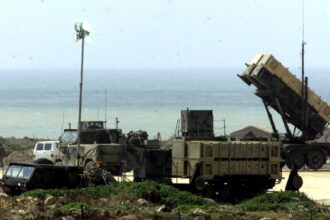
U.S. Starts Rationing Air Defenses Against Iranian Strikes
U.S. commanders are deliberately allowing some Iranian missiles and attack drones through their air defenses, accepting damage to military installations rather than expend interceptors that are growing harder to replace, according to NBC News.Two senior U.S. officials told NBC News that commanders have been choosing which incoming weapons to intercept since the early days of the Iran war. They may withhold defensive missiles when a projectile is assessed as unlikely to hit American forces, significantly damage critical U.S. facilities or threaten regional allies. The result is a tiered defense: personnel and critical infrastructure are protected first, while secondary facilities may be allowed to absorb some damage.The officials said some Iranian weapons have consequently struck parts of U.S. bases where personnel were not present. They were not aware of any American troops or civilians being harmed by projectiles commanders deliberately chose not to intercept.Selective engagement is a normal part of missile…

Khan’s Ouster Deepens ICC’s Crisis
International Criminal Court member states removed prosecutor Karim Khan on July 24 for "serious misconduct and serious breach of duty." 82 states voted for removal, 13 against and 15 abstained, marking the first dismissal of a chief prosecutor in ICC history.Khan had been suspended since June over sexual-misconduct allegations involving a subordinate. Documents reviewed by AP said he had an inappropriate relationship and tried to deter her complaint. He denies wrongdoing and calls the process unfair. Khan's lawyers and some rights groups note an internal judges' panel had found insufficient evidence, a conclusion the Assembly's Bureau overrode. His deputies will lead.The scandal strikes at the ICC's moral authority as Washington escalates its campaign against the court. Trump's administration sanctioned Khan and several judges after warrants for Netanyahu and Yoav Gallant. On July 13, Secretary of State Marco Rubio vowed to "systematically disable" the court. The US cannot withdraw because it…

Saudi Arabia, UAE Signal Renewed Unity
Saudi Defense Minister Khalid bin Salman and UAE Vice President and Deputy Prime Minister Sheikh Mansour bin Zayed. @Turki_alalshikh/X.Saudi Arabia and the United Arab Emirates have staged a coordinated show of unity, an effort to contain a widening rift between the Gulf's two most powerful Arab states.Saudi Media Minister Salman Al-Dosary and UAE National Media Authority chairman Abdulla Alhamed posted near-identical statements at 7 p.m. on Tuesday, praising both leaderships and urging outlets not to undermine relations – a state-media directive as much as a sentiment. A photograph of Khalid bin Salman and Sheikh Mansour bin Zayed, arms around each other, was shared by Saudi royal court adviser Turki Alalshikh; Emirati adviser Anwar Gargash wrote that spears "refuse to be broken" together and "break if they part."The choreography amounted to a coordinated effort to control the public narrative and project restraint while Gulf security remains under pressure.The split runs deeper…
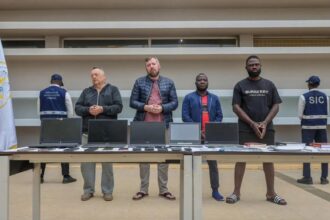
Angola Jails Russians Over Influence Plot
An Angolan court has sentenced two Russian nationals over an alleged operation to destabilise the country before its 2027 election. Political consultant Igor Ratchin received 11 years and interpreter Lev Lakshtanov eight, on charges from espionage to terrorism that carried up to 15 years; summaries differ on which of eleven counts produced the convictions.Prosecutors said the pair spread false information among anti-government protesters during the 2025 fuel-price unrest, in which dozens died, recruited local activists, planned a fresh wave of protests and intended to finance the opposition UNITA. The defendants denied the charges, saying they had come to establish a "Russian House" cultural centre; their lawyers said the file held no evidence of terrorism.Ratchin had worked on Russian regional election campaigns; Lakshtanov was a longtime military interpreter in Angola. Both were tied to Africa Politology, a network the US Treasury traced to Prigozhin's "Africa Back Office" of consultants manipulating African…
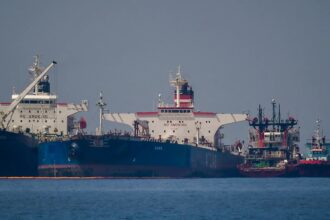
How Sanctions Created a Parallel Maritime System
What began in 2022 as a workaround to Western sanctions has evolved into one of the most important pieces of strategic infrastructure in the modern global economy. Russia depends on it to finance its war in Ukraine. Iran relies on comparable networks, built over decades of sanctions, to keep exporting oil despite renewed U.S. pressure. Together, these systems increasingly form a parallel maritime order operating alongside – but increasingly outside – the traditional rules governing international shipping.Recent events on both fronts illustrate the shift. Ukraine has expanded its campaign against vessels linked to Russia's shadow fleet, while renewed fighting between the United States and Iran has again placed commercial shipping at the center of the confrontation around the Strait of Hormuz. Merchant shipping is no longer merely operating alongside these conflicts. It has become one of the principal ways through which economic pressure, military strategy and geopolitical competition intersect.From Sanctions…
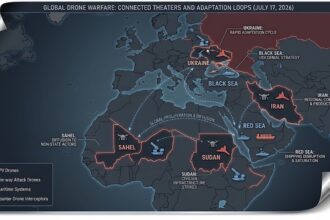
Drone Warfare Is Becoming One Global Battlefield
Drones are no longer supporting weapons used alongside artillery, aircraft and missiles. Across several of the world's most active conflicts, they now shape how forces find targets, hold territory at risk, protect infrastructure and impose costs on opponents.Ukraine remains the most important testing ground. Its armed forces and defense-technology sector can modify designs, software and tactics within days. Russia has answered with expanded domestic production, new countermeasures and adapted low-cost systems. The same logic now extends well beyond Eastern Europe. Iran has turned one-way attack drones into instruments of regional coercion. The Houthis have used unmanned systems against shipping and naval forces in the Red Sea. In Sudan and the Sahel, state forces, militias and insurgent groups are acquiring capabilities once limited to advanced militaries.These threads are not centrally directed. Technologies are transferred, copied, commercially sourced or developed independently under similar pressures. But together they are producing a connected global…
